
Self-awareness isn't enough.
Why you can understand yourself completely and still stay stuck.


We all know the woman.
She knows everyone’s attachment styles; she understands that she’s a people-pleaser, a co-dependent, and has a habit of taking too much responsibility for others’ feelings. She’s clued up on the latest theories; she’s listened to the podcasts, read all the books. She gives out advice like she’s an expert, always sending poignant quotes to her friends, tagging them in posts that perfectly summarise their situations. She’s been to therapy, has done ‘the work’, and consequently, she knows everything there is to know about her childhood, how she came to be the way she is, and the root of the behaviours she keeps repeating. She knows the why. And yet she remains stuck. All that self-awareness hasn’t healed her.
She is us. We are her.
I have seen this person in my therapy room time and time again. I have been this person in my own therapy - entirely aware of the problem, and yet still unable to change it.
We have come to believe that if we can just understand our patterns deeply enough, find the right label, identify the root cause, or uncover the perfect explanation, then change will naturally follow.
And why wouldn’t we? We live in a culture that’s obsessed with self-awareness. We live in a culture obsessed with self-awareness. We are constantly encouraged to look inward, analyse ourselves, identify our triggers, learn our attachment style, understand our childhood wounds and make sense of our behaviours. We’re inundated with constant content, all of it giving the message that if we can just understand enough, if we just find the perfect explanation or theory to explain what’s going on, then this will somehow change things.
This awareness can be incredibly valuable. The content we see might resonate, it might trigger an interesting new perspective, or help us understand where our struggles come from. Awareness can shine a light on patterns we were previously repeating without realising. It can help us make sense of ourselves with greater compassion.
But somewhere along the way, many of us have started believing that awareness itself is the cure.
This pulls us into an endless search. We scroll, we read, we listen, searching for more insight, more labels, more self-awareness. And yet, we stay stuck. We know why we’re attracted to a certain type of person, why we get triggered by a certain behaviour, why our coping mechanisms developed or why we shut down in conflict - but knowledge doesn’t stop us from doing those things.
Because all the while, we’re ignoring the thing that actually needs to change - letting go of the thing we’re unconsciously holding on to.
The part we’re not aware of
There is almost always an unconscious motivation for the behaviours that we don’t want. Whether it’s a coping mechanism (such as gambling, exercise, overworking, drinking, eating, not eating), an emotional response, a behaviour or a familiar dynamic that keeps showing up over and over again - there will be a part of you don’t this for a reason.
The question isn’t only why you want to change; it’s what part of you benefits from staying the same.
Until we both understand AND let go of that reason, the issue will persist. So it’s not that the understanding isn’t helpful - it’s the first necessary step - but we also have to connect to the part that’s holding us back and let go of it.
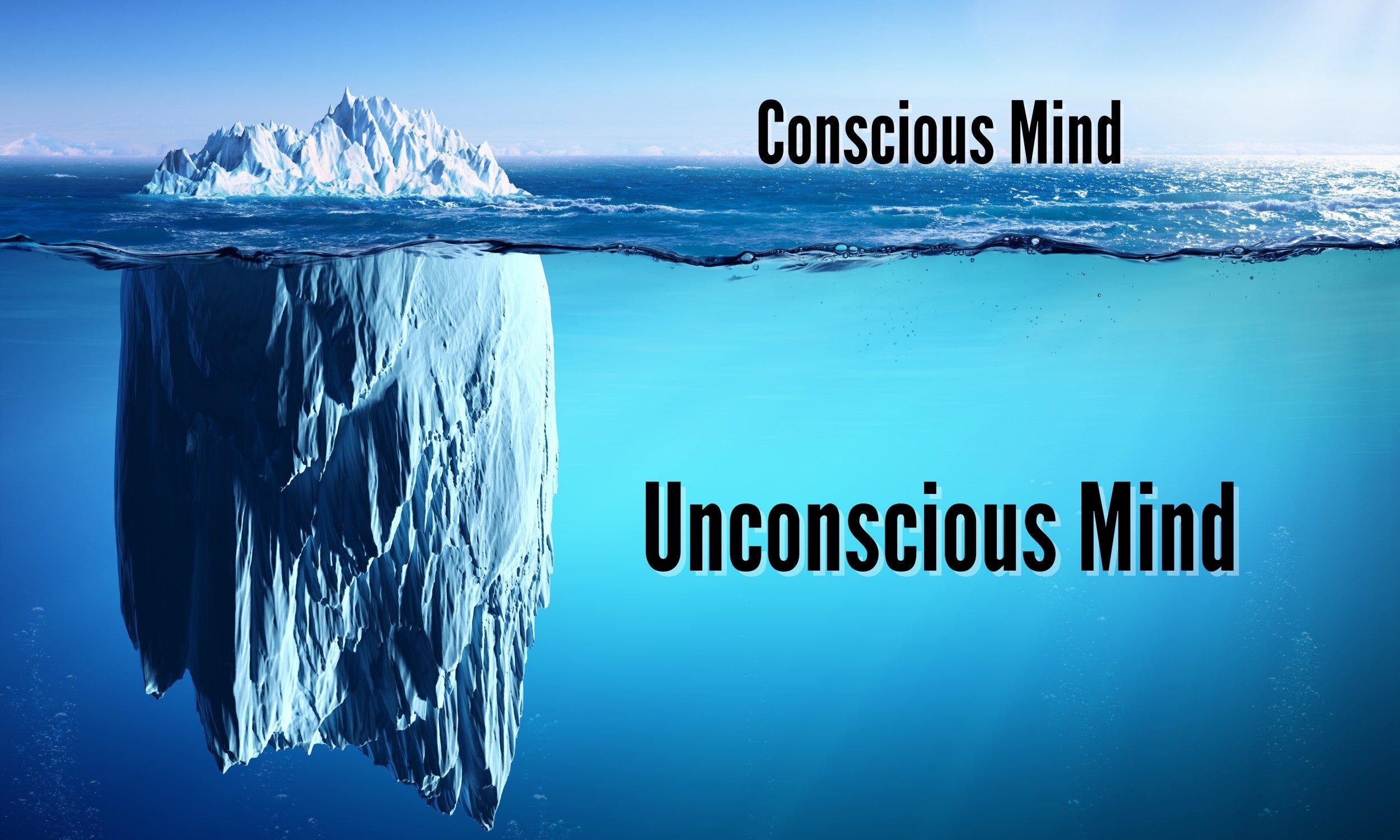
Remember, the mind is an iceberg. If we stick with just insight and self-awareness alone - will still stay at the tip of the iceberg. We have to get to what’s underneath, and this isn’t something that’s easy to do without someone else pointing out our blind spots.
For example. Let’s say someone is continuing to choose emotionally unavailable or avoidant partners. They say they are sick of this; they just want someone secure and available to love them. At the same time, they might carry a wound from childhood in which one of their parents was unavailable. They’re fully aware that they’re repeating the same dynamic by being attracted to similar romantic partners. But how do they stop? There might be an unconscious motivation here that is keeping her pursuing these relationships. Perhaps there’s a fantasy that she can convince someone to love her, that she can rewrite the story of her past. Change happens not just because she understands the pattern, but when she starts grieving the fantasy that one day, if she’s ‘good enough’ she can make an unavailable person choose her. In a sense, she needs to grieve for what she didn’t get, and that there’s nothing she can do to correct the past.
The same might be true for people struggling with painful feelings, such as depression or anxiety. There is usually an unconscious reason.
Let’s say someone comes to therapy desperate to get rid of their anxiety. This person spends hours worrying about her health, her body, and what people think of her. They try all the tips to get rid of the anxiety, they regulate the nervous system, they incorporate the tools, but it doesn’t take the anxiety away. They already know why they’re anxious - it’s an attempt to protect them from feeling out of control - but this only goes so far. The anxious person already knows they fear uncertainty; what they haven’t yet done is experience the uncertainty they’ve spent years trying to avoid.
The key is that they need to let themselves feel out of control, to let in the uncertainty they’re protecting against. The knowledge is useful, but not on its own. True change would come not from recognising the need for control intellectually, but really experiencing the helplessness that would come without the catastrophising and worry. And we could interrogate further - why is the uncertainty so hard to feel, what are they really protecting themselves against? Perhaps it would mean feeling vulnerable, or dependent on others, or having to go through the possibility of rejection. Whatever the fear, it’s really connecting to it, and then processing the thing we’re afraid of that creates change.
It’s confusing because awareness is still at the heart of what helps us change, butit’s an embodied awareness, a getting in touch with something we’ve previously disavowed. This is different from ‘I know I do this because XYZ happened’. This kind of awareness can be useful, but without the feeling, without the discomfort, it might not be enough.
We’ve been taught by therapy culture that the answer is self-awareness. But this culture colludes with our desire to intellectualise. We think that if we can understand something, then we can master it. But often intellectualising and self-awareness actually takes us away from truly connecting to whatever it is we don’t want to face.
Real change doesn’t come from insight; it happens when we can finally bear what we’ve spent years protecting ourselves from.
Yup, retired therapist here, and I very much enjoyed this post. Thank you. Years of training and my own therapy, and several years of seeing clients, and I still couldn't sort out an important issue of my own. I could see it, understand its origins and mechanisms, and contemplate the wazoo about it, but it would still sometimes floor me. Emotional work is where it's all at. The Righteous Mind is an excellent read on the relationship between rationality and emotions and I'm a fan of Emotionally Focussed Therapy, which when done well, uses emotions to address and heal other emotions, especially in the context of relationships.
Awesome post, beautifully written. It's so true that insights feel transformation. Yet you're right, they're a beginning rather than the resolution.
I found this to be helpful in relationships. Insights are great but if nothing is done about them to grow, progress, or improve, then they mean crap all don't they? :)
Cheers for the effort you've put into this. Have a fab day :)